Today, I’m taking a closer look at the growing pressure so many of us feel around health optimization, especially during midlife, when simply keeping up with the latest wellness and beauty trends and advice can start to feel like another full-time job.
I’m breaking down why health information and solutions constantly inundate us, and the mental and financial costs of trying to do it all, and I’m sharing practical ways to bring more ease and intention back into our daily routines.
If you’ve ever felt overwhelmed by constantly shifting “rules” or found yourself buried in trackers, apps, wearables, and endless wellness products, this episode is your permission slip to turn down the noise and refocus on what truly supports your well-being. We can reclaim self-care as something that fits into our lives rather than another source of stress.
Show Highlights:
- The growing weight of health advice. 00:53
- Understanding the strategic health industry trap. 03:51
- The engineered pressure to solve perceived problems. 06:18
- Tracking fatigue and why more data isn’t always better care. 07:12
- Consciously choosing what not to track or act upon. 09:37
- Shifting from performative to supportive self-care. 10:18
- What should be the actual role of health and self-care? 11:38
- Practical steps to curate health inputs and regain balance. 12:43
- Where does vanity pressure end and health begin in marketing? 15:06
Subscribe to the Brilliant Balance Weekly: http://www.brilliant-balance.com/weekly
Follow Cherylanne on Instagram: http://www.instagram.com/cskolnicki
Episode #433 – Full Transcript
This is episode 433 of the Brilliant Balance podcast, When Health Optimization Becomes Another Job. So welcome back to the show. I’m Cherylanne, if we’re just meeting. And today, we’re going to talk about something that has been, I think, weighing on the women in my coaching community. And I suspect it may also be weighing on you, even if you haven’t necessarily had the words for it.
And that is the fact that we are being bombarded with so much information and so many ideas about things we can do to optimize and improve our health—particularly if you are in midlife like I am—that keeping up with all of it is starting to feel like a job. Like, literally, it could be a job.
And I think for me, this really hit home a few months ago. I was standing in my kitchen. I had my phone in my hand, of course, scrolling through Instagram, realizing how many of the posts I was being shown—particularly the ads I was being fed—were for something I could definitely categorize as health-related. Some of that might have been a stretch, because if I said health- and beauty-related, for sure it would be most of my feed. Maybe that tells you something about what I’ve clicked on, right?
So supplements, blood tests I could have run, podcast recommendations, influencers talking about health—particularly at midlife—hormone replacement therapy, which by the way, I’m a big believer in, protein targets, longevity, red light therapy, cold plunges, magnesium. I mean, there are apparently several kinds of magnesium, and we should definitely know which one we should be taking, right?
And I remember thinking very clearly: when did this all start to feel like a job? It does not feel supportive. It doesn’t feel nurturing. It doesn’t feel like something I’m doing for myself. It feels like a long list of things I now have to do just to keep up.
And so if you are in this life stage, you’re probably trying to do all of the right things for your health, right? Or for your appearance. And we can just go ahead and blend them here, because half of the stuff that’s appearance-related is being billed as health-related.
But it’s starting to make you feel overwhelmed or behind, or like you’re failing at something where the rules just keep changing. So today, I want to slow this down a little bit. I want us to talk about why this is happening, maybe what it’s costing us—not just financially, which it definitely is, but also in terms of headspace. And then how we can bring some sensibility back to this in a way where the things we’re doing for our own health and well-being actually feel supportive instead of mandatory.
There are a few angles I want to get into today. The first one is this didn’t happen by accident. Let’s start there, because I think it really matters. If you feel like health has become loud and complicated and relentless, that’s not because you’re obsessed, or you’re doing it wrong, or you need a lot of help. It’s happening because we are living inside of a massive industry.
The health, wellness, and longevity industry is big. And we are the ideal customer. Why? Because we care. We’re responsible. We have resources. And we’re standing at a period of life where our bodies are changing in ways we didn’t choose and maybe weren’t prepared for.
And when you add the fear of aging to the promise of control, you get a really powerful message. It probably sounds something like: if you just do enough, track enough, and optimize enough, you can stay ahead of this.
But notice what sneaks in alongside that message—there’s a little bit of morality. It becomes, “If you want to be good, you’ll do this.” There are good choices and bad choices. Discipline versus neglect. There’s also this idea that there’s a problem to be solved.
Your age, your appearance, your health—this is framed as a problem, not as a life stage, not as a transition, not as something normal and natural. It’s framed as something you’d better fix. So if you’re feeling that pressure, I want you to acknowledge that pressure was created.
It’s structural. It’s cultural. It’s profitable. And that doesn’t mean all health information is bad, or that caring about your appearance and health is wrong. It means the volume, the loudness, the omnipresence, and the urgency of it all are not neutral.
We are being strongly influenced. And once you see that, you can lay down the self-blame for being overwhelmed. It is objectively overwhelming.
I remember going to the dermatologist for an annual skin check a couple of years ago. I walked into the room and was shocked by how many flyers and pamphlets were about things I could fix or change or tweak. I was just there to make sure I didn’t have skin cancer.
The level of marketing—creating problems I didn’t know I had, creating dissatisfaction I hadn’t even felt yet—is very real. We are sitting inside a massive marketing engine selling us health, wellness, and beauty-related solutions. And it’s important to remember that.
The second thing I want to talk about is how much tracking we’re doing. I’ll go on record: more isn’t always better. This tends to land heavily for high-achieving, Type A women. I work with a lot of them. I am one of them. We love to track things. Give us a spreadsheet, a tracker, data—we’re in.
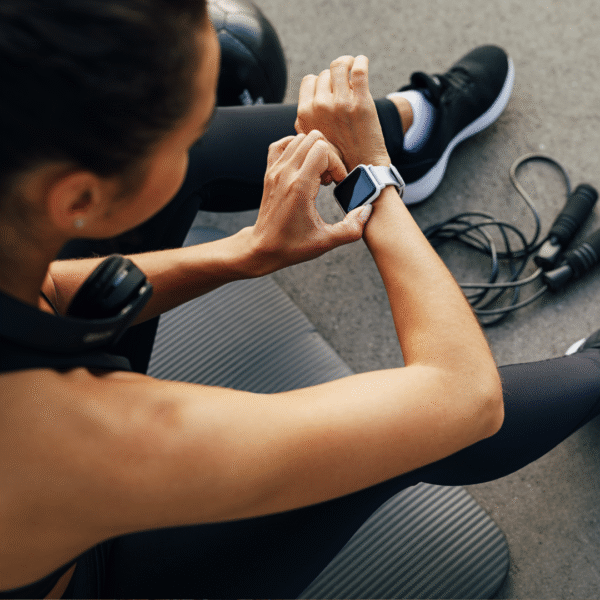
But more information isn’t the same as better care. We have access to more data than any generation before us: wearables, apps, trackers, tests, continuous feedback. The implicit promise is that if you just know more, you’ll finally get this right.
So now, in addition to selling us the solution, they sell us the data. But what we weren’t really taught is how much information is enough. So we accumulate more. We save posts. We screenshot. We add podcasts to our feed. We make notes for our doctors. We order supplements. We try protocols.
There’s this accumulation driven by the belief that more must be better. But more isn’t always better. More information isn’t always better. More solutions aren’t always better.
We have to draw a line around how much effort it’s reasonable to put into this, because otherwise we create this low-grade anxiety, this sense that we’re always a little behind. That’s mental labor. And it adds up.
I’ve had to make very deliberate choices about what I don’t track anymore—what doesn’t get access to my nervous system. Information I’m allowed to see and find interesting without acting on. Because just because you can monitor something doesn’t mean you have to.
Better self-care often looks like less noise, not more. So if you’re feeling overloaded, where can you turn down the volume so you can trust your intuition again?
The third thing I want to talk about is effort. This community of women—you effort so hard. I’m right there with you. But it doesn’t have to be that hard to be effective.
Many of us grew up believing effort equals virtue. If it matters, you work at it. If it’s not hard, it doesn’t count. But this phase of life feels like a recalibration. Maybe it’s moving from being performative to being supportive.
I’m not anti-health. I invest in my health. I make intentional choices. I’m not opting out. But I am opting out of turning this into another job.
Our self-care and healthcare should support our life, not compete with it. So if the practices you’ve accumulated are draining your capacity, increasing your anxiety, or making you feel like you’re never doing enough, pay attention. Ease is transformative.
Practically speaking, this starts with deciding where you are in life and what you want right now. You don’t have to push all the time. What feels supportive in this chapter?
Next: who are you going to listen to? Tighten the circle. One or two trusted healthcare providers. One or two trusted sources. Everything else is noise.
Use that filter to decide what spurs you to action and what you let pass by. “That’s interesting. I’m not doing that right now.”
Because the fear of being left behind can push us into choices we never would’ve made otherwise.
There’s also an important line between healthcare and beauty care. They overlap, but we’re susceptible to marketing in both. Healthcare can feel more virtuous, so we don’t always question it as closely.
I care deeply about my health—and yes, my appearance—but I don’t want it to feel like another job. I want those practices to support the life I’m living.
If health optimization is taking up so much headspace that it’s pulling you away from other things, that’s a red flag. Ask yourself: if I’m obsessively focused here, what am I not paying attention to?
We don’t need to do everything perfectly. We need a small collection of practices that fit into our life—not take it over. That requires boundaries and trust in yourself.
If this episode resonated with you, I hope you’ll share it with a friend. It really matters. Thank you so much for listening and tuning in today. That’s all for now. Until next time, let’s be brilliant.